



LANGUAGECERT ASSESSMENT
A Global Leader in English Assessment and Certification Services

For all age groups
Multi-level English examinations
Academically Authoritative
Widely recognised by universities worldwide
Four language skills
Comprehensive assessment of listening, speaking, reading, and writing
Three exam series
Meeting the diverse needs of learners and educators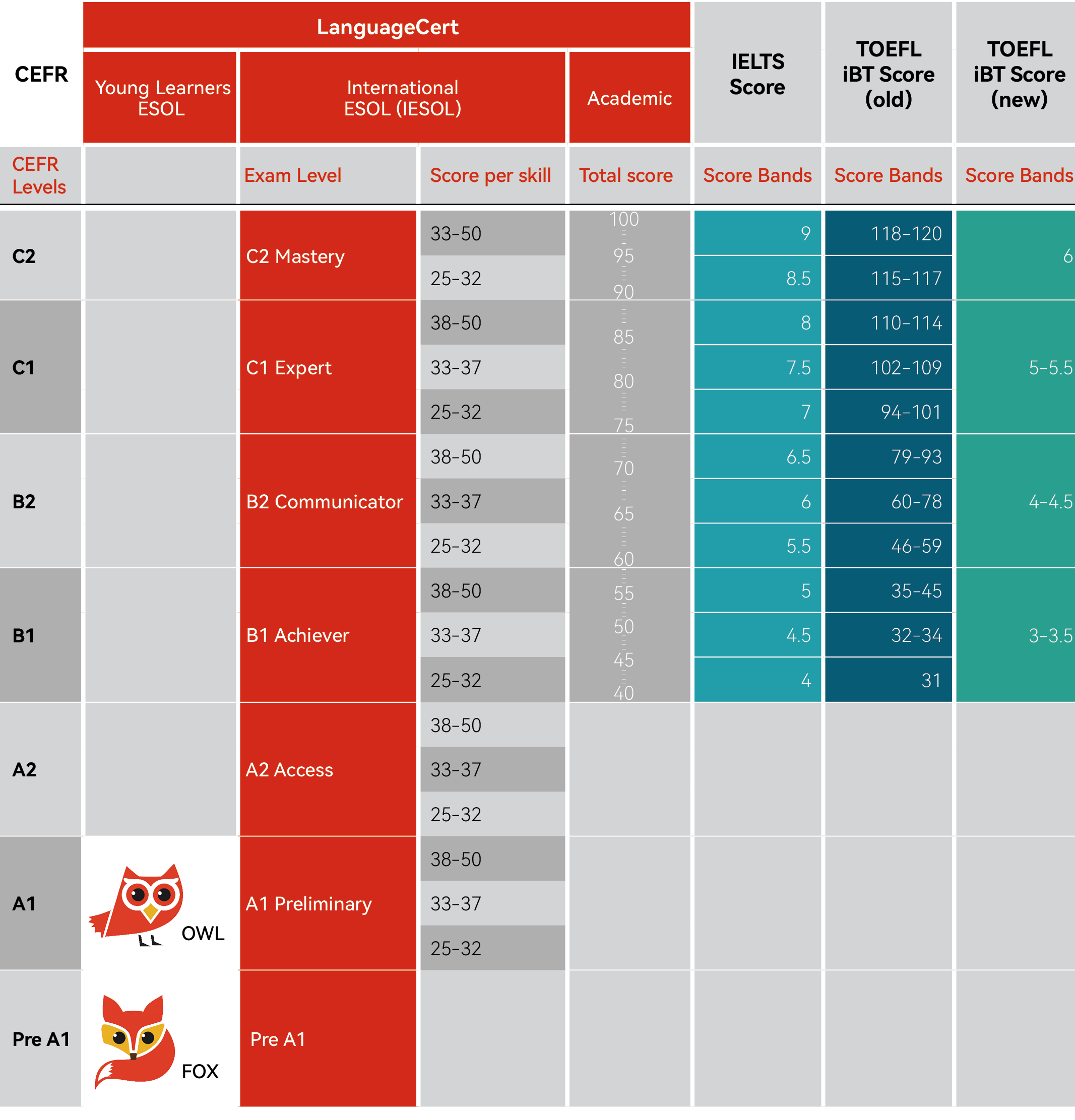

LanguageCert Young Learners ESOL | Basic Exam Information
 YL ESOL Fox
Exam Level CEFR Pre-A1
| Written Exam Format & Duration | Written test score | Written Test Certificate / Oral Test Certificate | Oral examination duration/score | Suitable for students |
|---|---|---|---|---|
Paper-based exam: 1 hr
|
Total Written Score: 41 Listening 15 / Reading 20 / Writing 6 | All candidates receive a certificate. The number of foxes awarded in each skill area (1–4) reflects the candidate’s performance | Speaking Test Duration: 5 mins Speaking Test Full Score: 16 | Suitable for students aged 6 and above |
 YL ESOL Owl
Exam Level CEFR A1
| Written Exam Format & Duration | Written test score | Written Test Certificate / Oral Test Certificate | Oral examination duration/score | Suitable for students |
|---|---|---|---|---|
Paper-based exam: 1 hr 15 mins
|
Total Written Score: 55 Listening 20 / Reading 25 / Writing 10 | All candidates receive a certificate. The number of owls awarded in each skill area (1–4) reflects the candidate’s performance | Speaking Test Duration: 7 mins Speaking Test Full Score: 16 | Suitable for students aged 6 and above |
YL ESOL FOX | Scoring Criteria
| Section | 1x |
2x |
3x |
4x |
| Listening | 0-4 | 5-8 | 9-12 | 13-15 |
| Reading | 0-5 | 6-10 | 11-16 | 17-20 |
| Writing | 0-1 | 2-3 | 4-5 | 6 |
| Speaking | 0-4 | 5-8 | 9-13 | 14-16 |
YL ESOL OWL | Scoring Criteria
| Section | 1x |
2x |
3x |
4x |
| Listening | 0-5 | 6-10 | 11-16 | 17-20 |
| Reading | 0-7 | 8-13 | 14-20 | 21-25 |
| Writing | 0-2 | 3-5 | 6-8 | 9-10 |
| Speaking | 0-4 | 5-8 | 9-13 | 14-16 |
LanguageCert Young Learners ESOL Level 1 | YL ESOL FOX Exam Format
· Written Exam Format
| Listening | Reading | Writing | |
|---|---|---|---|
| Format | Part 1: Multiple Choice (5 questions) Task: Listen and look at the pictures, then choose the correct answer Part 2: Matching (5 questions) Task: Listen and match the descriptions to the correct pictures Part 3: Spelling (5 questions) Task: Listen and write a word or a number in each gap | Part 1: Matching (5 questions) Task: Match the words to the correct pictures Part 2: True or False (5 questions) Task: Look at the picture, read the sentence, and decide whether it is true or false Part 3: Multiple Choice (5 questions) Task: Choose the correct options to complete the text Part 4: Short Answers (5 questions) Task: Look at the pictures, read the questions, and write one-word answers | Part 1: Task: Write 3 sentences about personal information Part 2: Task: Look at the picture and write three simple sentences to describe it |
· Speaking Exam Format
| Speaking | |||
|---|---|---|---|
| Format | Part 1 Task: Answer simple questions about personal information (name, age, etc.) | Part 2 Task: Identify two objects shown on a picture card and answer follow-up questions | Part 3 Task: Look at a scene card, answer simple questions about the picture, and respond to three follow-up questions on the same topic. |
LanguageCert Young Learners ESOL Level 2 | YL ESOL OWL Exam Format
· Written Exam Format
| Format | |||
| Listening | Part 1: Multiple Choice (5 questions) Task: Listen and look at the pictures, then choose the correct answer Part 2: Matching (5 questions) Task: Listen and match the descriptions to the correct pictures | Part 3: Multiple Choice (5 questions) Task: Listen and look at the pictures, then choose the correct answerPart 4: Spelling (5 questions)Task: Listen and write one word or one number | |
| Reading | Part 1: Yes / No (6 questions) Task: Look at the picture, read the sentence, and write Yes or No Part 2: Multiple Choice Cloze (5 questions) Task: Choose the correct option to complete each gap in the text | Part 3: Matching (6 questions) Task: Choose the correct option to complete each gap in the textPart 4: Short Answers (8 questions) Task: Read a short story and answer the questions using one word only | |
| Writing | Part 1: Task: Write four sentences describing a real-life situation | Part 2 Task: Look at the pictures and write two sentences about each picture (six sentences in total) | |
· Speaking Exam Format
| Format | ||
|---|---|---|
| Speaking | Part 1 Task: Answer simple questions about yourself (e.g. name, age and hobbies) Part 2 Task: Identify objects belonging to the same category and answer related questions | Part 3 Task: Look at a Spot-the-Difference task card and describe the differences Part 4 Task: Look at a scene card and describe the picture |
Comprehensive Teaching Resources


Certificate Template


LanguageCert IESOL | Basic Exam Information
| International ESOL | ||||||
|---|---|---|---|---|---|---|
| Category | A1 | A2 | B1 | B2 | C1 | C2 |
| Written Exam Format |
|
Paper-based, computer-based or online remote-proctored exam | Paper-based, computer-based or online remote-proctored exam | |||
| Written Exam Duration | 1 hr 40 mins • Listening: approx. 20 mins • Reading & Writing: 1 hr 20 mins | 2 hrs 40 mins • Listening: approx. 30 mins • Reading & Writing: 2 hrs 10 mins | 3 hrs 10 mins • Listening: approx. 30 mins • Reading & Writing: 2 hrs 40 mins | |||
| Written Exam Score | 150 marks total (Listening 50 / Reading 50 / Writing 50) | |||||
| Written Exam Certification | Candidates who achieve 75 marks or above are awarded a certificate | |||||
| Speaking Test Duration | 6 mins | 9 mins | 12 mins | 13 mins | 15 mins | 17 mins |
| Speaking Test Score | 50 marks total | |||||
| Speaking Test Certification | A certificate is awarded for a score of 25 marks or above. | |||||
| Recommended Age Group | No age restriction Recommended for ages 7–10 | No age restriction Recommended for ages 10–12) | No age restriction Recommended for ages 13–15 | No age restriction Recommended for ages 16–18 | No age restriction Recommended for ages 18+ | |
LanguageCert IESOL | Sample Exam Format
· A1 Written Exam Format
| Listening | Reading | Writing | |
|---|---|---|---|
| A1 | Part 1: 7 Multiple-Choice Questions Listen twice and match 7 short statements to the corresponding letter, word, picture or symbol. Part 2: 7 Multiple-Choice Questions Listen twice and choose the most appropriate response to 7 short utterances. Part 3: 6 Multiple-Choice Questions Listen twice to 6 short dialogues and identify information such as topic, purpose, context, speaker relationship, attitude and opinion Part 4: 6 Multiple-Choice Questions Listen twice to a dialogue and identify specific information. | Part 1: 6 Multiple-Choice Questions Choose the correct option to complete each sentence. Part 2: 5 Multiple-Choice Questions Choose the correct option to complete the text. Part 3: 7 Multiple-Choice Questions Select the correct text for each question. Part 4: 8 Questions Select the correct option for each statement. | Part 1: 4 Sentences, approx. 30 words (Communicating ideas or basic information) Write four sentences on a given topic, such as yourself, your daily life, people you know, your home or everyday activities Part 2: 20–30 Words(A short, simple text for a specific audience) Write a letter, card, postcard or message based on two given communicative functions. |
· A1 Speaking Exam Format
| Speaking | |||
|---|---|---|---|
| A1 | Part 1: Personal Information
|
Part 2: Role Play
|
Part 4: Topic Presentation
|
IESOL A2 |Format
· Written Assessment Format
| Format | ||
|---|---|---|
| Listening | Part 1: 7 multiple choice questions (each with 3 options) Task: Listen twice to match 7 short sentences to letters, words, graphics, and symbols Part 2: 7 multiple choice questions (each with 3 options) Task: Listen twice to choose the best reply to 7 short sentences | Part 3: 6 multiple choice questions (each with 3 options)
Task: Listen twice to 6 short conversations between 2 speakers to identify: topic, purpose, context, speakers, gist, relationship between speakers, functions, attitudes, feelings, and opinions
Part 4: 6 questions (a form with 6 headings)
Task:
|
| Reading | Part 1: 6 multiple choice questions (each with 3 options) Task: Choose the correct multiple-choice option to fill in the gaps Part 2: 6 multiple choice questions (fill in an incomplete text, 1 option is a distractor) Task: Choose the correct options to fill the gaps in the text | Part 3: 7 multiple choice questions (each with 3 options) Task: Choose the correct text for the corresponding question Part 4: 7 multiple choice questions (each with 3 options) Task: Choose the correct multiple-choice option for the corresponding statement |
| Writing | Part 1: 30 - 50 words (communicate ideas or basic information) Task: Write a letter on a given topic Part 2: 30 - 50 words (short simple text for an intended audience) Task: Write a letter, card, postcard, or message | |
· Spoken Assessment Format
| Format | ||
| Speaking | Part 1 Task: • Give and spell name • State country of origin • Answer 5 questions Part 2 Task: • 2 or 3 situations are presented by the interlocutor • Candidates are expected to respond to questions and initiate interactions | Part 3 Task: Exchange information to identify similarities and differences in pictures depicting familiar situations Part 4 Task: • Candidates are given 30 seconds preparation time • Talk about a topic provided by the interlocutor for 1minute • Answer follow-up questions |
IESOL B1 | Format
· Written Assessment Format
| Format | ||
| Listening | Part 1: 7 multiple choice questions (each with 3 options) Task: Listen twice to 7 short sentences between 2 speakers, 1 being a formal conversation Part 2: 6 multiple choice questions (each with 3 options) Task: • Listen twice to 3 short conversations between 2 speakers to identify: topic, purpose, context, speakers, gist, relationship between speakers, roles, functions, attitudes, feelings, and opinions. • Choose the appropriate response for each question | Part 3: 7 questions (write notes on the message pad based on the information in the recording) Task: • Listen twice to the recording to identify specific information • Jot down answers consisting of 1 to 3 words Part 4: 6 multiple choice questions (each with 3 options) Task: • Listen twice to a discussion to identify gist, examples, fact, opinion, contrast, purpose, key ideas, attitude, cause and effect • Choose the appropriate response for each question |
| Reading | Part 1: 5 multiple choice questions (each with 3 options) Task: • 5 short texts each with 1 gap testing layout, lexis, cohesive devices, coherence • Choose the appropriate response for each question Part 2: 6 multiple choice options to fill in an incomplete text (1 option is a distractor) Task: Choose the appropriate sentence for each gap in the text | Part 3: 7 questions (4 texts provide the answers to 7 questions) Task: Read the 4 short texts, e.g. email, article, advert, etc., and choose which text answers which question Part 4: 8 questions (requiring short answers of 1 to 3 words) Task: A continuous text: narrative, descriptive, expository, biographical, instructive |
| Writing | Part 1: 70 - 100 words (respond appropriately to a given text in order to produce a formal response for an intended public audience) Task: Write a response to a letter, poster, diary, timetable, leaflet, etc for a specified reader addressing a clearly defined number of content points Part 2: 100 - 120 words (produce an informal letter to a friend) Task: Write a letter on a given topic of personal interest and include 2 functions e.g. invite a friend to stay, describe what you will do | |
· Spoken Assessment Format
| Format | ||
| Speaking | Part 1 Task: • Give and spell name • State country of origin • Answer 5 questions Part 2 Task: • 2 or 3 situations are presented by the interlocutor • Candidates are expected to respond to questions and initiate interactions | Part 3 Task: Hold a short discussion to make a plan, arrange or decide something using visual prompts Part 4 Task:: • Candidates are given 30 seconds preparation time • Talk about a topic provided by the interlocutor for 1 and a half minutes • Answer follow-up questions |
IESOL B2 | Format
· Written Assessment Format
| Format | ||
| Listening | Part 1: 7 multiple choice questions (each with 3 options) Task: Listen twice to 7 unfinished conversations between2 speakers; 1 being a formal conversation Part 2: 6 multiple choice questions (each with 3 options) Task: • Listen twice to 3 conversations each consisting of 2 speakers to identify: topic, purpose, context, speakers, gist, relationship between speakers, roles, functions, attitudes, feelings, and opinions; • Choose the appropriate response to complete or continue each question | Part 3: 7 questions (write notes on the message pad based on information in the recording) Task: • Listen twice to a radio broadcast, narrative, presentation, etc to identify specific information; • Jot down answers of 1 to 5 words Part 4: 6 multiple choice questions (each with 3 options) Task: • Listen twice to a discussion to identify gist, examples, fact, opinion, contrast, purpose, key ideas, attitude, cause, and effect • Choose the appropriate response for each question |
| Reading | Part 1: 6 multiple choice questions (each with 3 options) Task: 1 long text: news story, article, review, or proposal; Choose the appropriate response for each question Part 2: 6 multiple choice options to fill in an incomplete text (1 is a distractor) Task: • A text with 6 sentences removed, e.g. topic sentence, summarising sentence, developing idea, emphasising a point, opinion, contrast, sequence, forward and back reference, transition to new idea • Choose the appropriate sentence for each gap | Part 3: 7 questions (4 texts provide the answers to each question) Task: Read the 4 short texts, e.g. email, article, advert, etc., and choose which text answers which question Part 4: 7 questions (requiring short answers of up to 5 words) Task: Read a continuous text and answer questions clearly and completely |
| Writing | Part 1: 100 - 150 words (produce a formal response for an intended public audience) Task: Respond appropriately to the intended reader using a clearly defined number of content points Part 2: 150 - 200 words (produce a personal letter, a narrative composition/ story, or a descriptive composition) Task: Produce an informal piece of writing for a specified reader on a general subject | |
· Spoken Assessment Format
| Format | ||
| Speaking | Part 1 Task: • Give and spell name • State country of origin • Answer 5 questions Part 2 Task: • 2 or 3 situations are presented by the interlocutor • Candidates are expected to respond to questions and initiate interactions | Part 3 Task: Hold a short discussion to make a plan, arrange or decide something using visual prompts Part 4 Task: • Candidates are given 30 seconds preparation time • Talk about a topic provided by the interlocutor for 2 minutes • Answer follow-up questions |
IESOL C1 |Format
· Written Assessment Format
| Format | ||
| Listening | Part 1: 6 multiple choice questions (each with 3 options) Task: • Listen twice to 6 unfinished conversations between 2 speakers • Conversations will include idiomatic expressions, colloquialisms, register shifts, and use of stress and intonation to indicate attitude • Choose the appropriate option to complete each conversationPart 2: 6 questions(each with 3 options) Task: • Listen twice to 3 conversations and identify: topic, purpose, context, speakers, gist, relationship between speakers, roles, functions, attitudes, feelings, and opinions • Choose the appropriate option for each question | Part 3: 7 questions (write notes on the message pad based on the information in the recording) Task: • Listen twice to a dense, factual lecture, radio broadcast, narrative, presentation, etc. to identify specific information • Jot down answers consisting of 1 to 5 words Part 4: 7 multiple choice questions (each with 3 options) Task: • Listen twice to a discussion to identify gist, examples, fact, opinion, contrast, purpose, key ideas, attitude, cause and effect • Choose the appropriate response for each question |
| Reading | Part 1: 5 questions (5 sentences identifying true and false statements about the text) Task: • Text includes idiomatic language, narrative or academicideas, arguments, and opinions • Determine whether the statements are true or false Part 2: 6 questions (8 sentences to choose from to complete 6 gaps in the text. 2 sentences are provided as distractors) Task: • A text with 6 sentences removed, e.g. topic sentence, summarising sentence, developing idea, emphasising a point, opinion, contrast, sequence, forward and back reference, transition to new idea • Choose the appropriate sentence for each gap | Part 3: 7 questions (4 texts provide the answers to 7 questions) Task: Read 4 short texts, e.g. email, article,advert, etc., and choose which text answers which question Part 4: 8 questions (requiring short answers of up to 5 words) Task: Provide short answers of up to 5 words for each question |
| Writing | Part 1: 150 - 200 words (respond appropriately to a given text to produce a formal response for an intended public audience) Task: Write a letter, report, argument, or article using a written, graphic or visual input for the intended reader expressing stance, opinion,justification, argumentation as appropriate Part 2: 250 - 300 words (produce a personal letter, a narrative composition/ story, or a descriptive composition) Task: Write an informal piece for a specified reader to persuade, argue or hypothesize, expressing mood, opinion, justification, evaluation, etc. | |
· Spoken Assessment Format
| Format | ||
| Speaking | Part 1 Task: • Give and spell name • State country of origin • Answer 5 questions Part 2 Task: • 2 or 3 situations are presented by the interlocutor • Candidates are expected to respond to questions and initiate interactions | Part 3 Task: Hold a short discussion to make a plan, arrange or decide something using visual prompts Part 4 Task: • Candidates are given 30 seconds preparation time • Talk about a topic provided by the interlocutor for 2minutes • Answer follow-up questions |
IESOL C2 |Format
· Written Assessment Format
| Format | ||
| Listening | 6 multiple choice questions (each with 3 options) Task: • Listen twice to 6 sentences • Idiomatic expressions, colloquialisms, register shifts, and use of stress and intonation to indicate attitude included • Choose the appropriate option to complete or continue the conversation Part 2: 6 multiple choice questions (each with 3 options) Task: • Listen twice to 3 conversations, each consisting of 2 speakers, and identify: topic, purpose, context, speakers, gist, relationship between speakers, roles, functions, attitudes, feelings, and opinions • Choose the appropriate option for each question | Part 3: 7 questions (write notes on the message pad based on the information in the recording) Task: • Listen twice to a dense factual lecture, radio broadcast, narrative, presentation, etc. to identify specific information • Jot down answers of 1 to 5 words Part 4: 7 multiple choice questions (each with 3 options) Task: • Listen twice to a discussion to identify gist, examples, fact, opinion, contrast, purpose, key ideas, attitude, cause and effect • Choose the appropriate response for each question |
| Reading | Part 1: 5 questions (5 sentences identifying true and false statements about the text) Task: • Text includes idiomatic language, narrative or academic ideas, arguments, and opinions • Determine whether the statements are true or false Part 2: 6 questions (8 sentences to choose from to complete 6 gaps in the text. 2 sentences are provided as distractors) Task: • A text with 6 sentences removed, e.g. topic sentence, summarising sentence, developing idea, emphasising a point, opinion, contrast, sequence, forward and back reference, transition to new idea • Choose the appropriate sentence for each gap | Part 3: 7 questions (4 texts provide the answers to 7 questions) Task: Read 4 short texts, e.g. email, article, advert,etc., and choose which text answers which question Part 4: 8 questions (8 questions requiring short answers of up to 5 words) Task: Task: Provide short answers of up to five words for each question |
| Writing | Part 1: 200 - 250 words (respond appropriately to a given text to produce a formal response for an intended public audience) Task: Write a letter, report, argument or article using a written, graphic or visual input for the intended reader expressing stance, opinion,justification, argumentation as appropriate Part 2: 250 - 300 words (produce a personal letter, a narrative composition/ story or a descriptive composition) Task: Write an informal piece for a specified reader in order to persuade, argue or hypothesise, expressing mood, opinion,justification, evaluation etc. | |
· Spoken Assessment Format
| Format | ||
| Speaking | Part 1 Task: • Give and spell name • State country of origin • Answer 5 questions Part 2 Task: • 2 or 3 situations are presented by the interlocutor • Candidates are expected to respond to questions and initiate interactions | Part 3 Task: Hold a short discussion to make a plan, arrange or decide something using visual prompts Part 4 Task: • Candidates are given 30 seconds preparation time • Talk about a topic provided by the interlocutor for 3 minutes • Answer follow-up questions |
LanguageCert IESOL | Exam Results
LanguageCert IESOL results are awarded at three levels: High Pass, Pass and Fail. For the written exam, scores of 75–100 achieve a Pass and 101–150 a High Pass. For the Speaking exam, scores of 25–37 achieve a Pass and 38–50 a High Pass. The Statement of Results includes individual scores for Listening, Reading, Writing and Speaking (maximum 50 marks per skill), together with additional feedback on Writing and Speaking performance. Successful candidates receive an internationally recognised LanguageCert International ESOL certificate. The table below shows the alignment between CEFR levels and LanguageCert scores.
LanguageCert IESOL | Certificates Template

Transcript Template


LanguageCert IESOL |Teaching Resources

Vocabulary List Covers all key vocabulary for each level, closely aligning classroom learning with exam requirements.

Teacher Guide Includes dedicated sections for Listening, Speaking, Reading, and Writing, offering structured preparation strategies to help teachers effectively address common classroom challenges.

International ESOL for SchoolsAssessing Writing Performance (Sample Scripts) Explains assessment criteria through model essays and examiner comments to help improve writing skills.
LanguageCert Academic |Exam Overview
- Exam Format & Duration: Total Duration: approx. 2 hrs 34 mins Listening: approx. 40 mins Reading: 50 mins Writing: 50 mins Speaking: approx. 14 mins
- Written Exam Scores: Listening: 30 marks | Reading: 30 marks Writing: • Task 1: 32 marks (40% of the Writing score) • Task 2: 32 marks (60% of the Writing score)
- Speaking Test Score:Total: 48 marks
- Recommended Candidates:No age restriction
LanguageCert Academic | Scoring System
Candidates receive individual LanguageCert Global Scale scores (0–100), an overall score (average of all four skills), and the corresponding CEFR level| LanguageCert Global Scale | CEFR | LanguageCert Academic |
|---|---|---|
| 90-100 | C2 | 90+ |
| 75-89 | C1 | 75-89 |
| 60-74 | B2 | 60-74 |
| 40-59 | B1 | 40-59 |
| 20-39 | A2 | - |
| 10-19 | A1 | - |
| 0-9 | Below A1 | - |
LanguageCert Academic | Exam Format

Part 1: Listen to seven incomplete conversations and choose the most appropriate response or continuation from three options.
Part 2: Listen to five academic-related conversations and answer two multiple-choice questions for each.
Part 3: Listen to an academic lecture or podcast and complete seven notes using no more than three words each.
Part 4: Listen to an academic group discussion or debate and answer six multiple-choice questions.
*Each listening section is played twice, whereas TOEFL and IELTS recordings are played only once

Part 1a: Read six sentences and choose the correct word or phrase to replace the highlighted item from three options.
Part 1b: Read a short text and choose the correct option to complete each gap.
Part 2: Read a short text and choose the correct sentences from eight options to complete the gaps.
Part 3: Read four short texts on the same topic and identify relevant information to answer the questions.
Part 4: Read a longer text containing academic arguments and answer six multiple-choice questions.

The Speaking test consists of four parts conducted by an examiner.
Part 1: Question &Answer — state and spell your name, give your nationality, and answer up to five questions.
Part 2: Role-play — complete two academic-related role play tasks by responding and initiating interaction.
Part 3: Reading Aloud — after 30 seconds of preparation, read a short academic text aloud and answer follow-up questions.
Part 4: Presentation — prepare for 1 minute, then give a presentation of up to 2 minutes on an academic topic and answer follow-up questions.

The Writing section consists of two tasks with different word count requirements.
Task 1:
Write a 150–200-word academic report or article based on visual information.Candidates are expected to present viewpoints, arguments, explanations, and analysis where appropriate.
Task 2:
Write an argumentative essay of approximately 250 words on an academic topic. The essay should persuade, argue, or hypothesize while expressing opinions, supporting arguments, and evaluation.
LanguageCert Academic Certificate & Sample Test Report


LanguageCert International Examinations | Teaching Resources
 Academic Qualification Handbook
● Explains the exam structure, aligns with CEFR standards, and outlines the assessment focus for each skill area
● Helps teachers design targeted teaching plans
 Writing Sample Scripts & Examiner's Comments
● Provides writing criteria and sample responses for different proficiency levels
● Guides learners in the use of advanced grammar, sophisticated vocabulary, and coherent organisation
 Lesson Plans
● Covers all four skills: Listening, Speaking, Reading, and Writing
● Provides teaching objectives, strategybased activities, and differentiated teaching suggestions
● Uses authentic exam materials to strengthen practical exam skills
 Official Practice Tests
● Simulates the format of the real examination
● Helps learners assess their proficiency and prepare effectively before the exam

Ms.Chen 18510986702

Ms.Guo 18510102716

Nsw,Wang 15618633087

Ms.Chen 16621598853

Ms.Rong 13128840868

Ms.Mao 15528212741